

MK-677 (Ibutamoren): Not a Peptide, Not a SARM, and the Merck Trial Record That Ended With a Heart-Failure Stop
The most common question about MK-677 is whether it is a peptide, and the most common answer is wrong. Ibutamoren is a spiroindoline sulfonamide, a small molecule Merck designed in 1995 so that it could be swallowed, and the only thing it shares with GHRP-6 or ipamorelin is the receptor. The larger omission is what happened next. Merck ran the compound through a dozen controlled trials over fifteen years, and IGF-1 rose in every one. Strength did not. Fat did not fall. Glucose went up. The last trial was stopped early for congestive heart failure. I read every trial abstract, the Nass 2008 full text, the current WADA list and the FDA's own warning letters, and this is what they say.
Research-use-only disclaimer: MK-677 (ibutamoren mesylate) supplied as a research chemical is intended strictly for in-vitro and laboratory research use and is not intended for human or veterinary use. The clinical trial results described below concern an investigational drug product, studied by Merck and now by Lumos Pharma as LUM-201, given under medical supervision in registered trials. They do not describe or support any use of research-grade material. No dosing or administration guidance appears in this article; trial dose arms are reported as study design facts. Nothing here is medical advice.

TL;DR
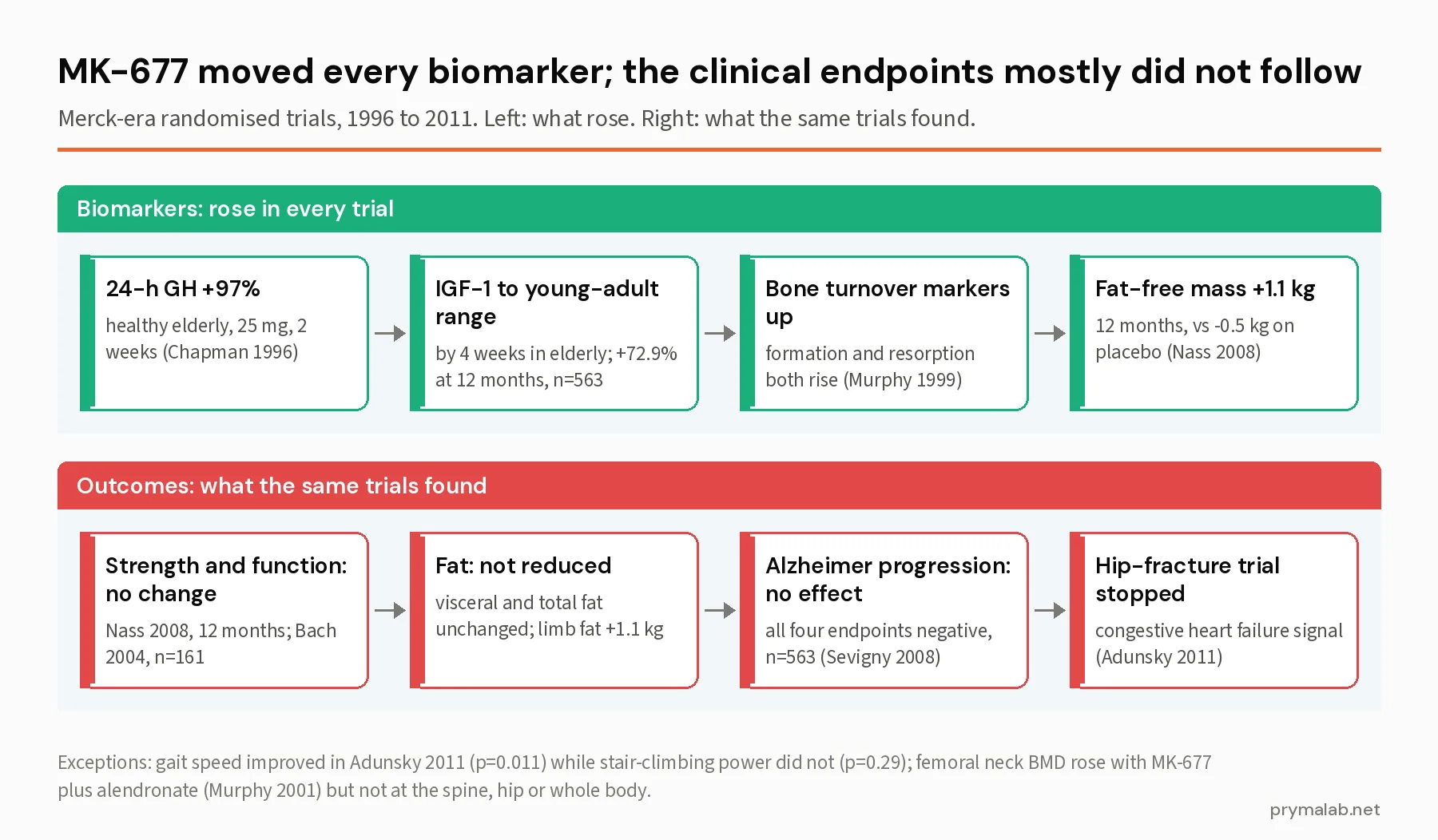
MK-677 (ibutamoren) is an orally active small-molecule agonist of the ghrelin receptor GHS-R1a, a spiroindoline sulfonamide with a solved cryo-EM structure bound to that receptor. It is not a peptide and not a SARM. In Merck's trials it raised 24-hour growth hormone by 97% in healthy elderly subjects and returned IGF-1 to the young-adult range for as long as 12 months. The clinical endpoints did not follow: fat-free mass rose 1.1 kg in a year with no change in strength or function, visceral fat did not fall, fasting glucose rose, a 563-patient Alzheimer trial was negative, and a hip-fracture trial was terminated early for a congestive heart failure signal. It has never been approved anywhere, is prohibited at all times under WADA section S2.2.4, is excluded from the US dietary supplement definition, and is named in seven FDA warning letters. The same molecule is in a Phase 3 paediatric trial as LUM-201. Research use only.
Not a peptide: A spiroindoline sulfonamide small molecule, C27H36N4O5S, 528.7 g/mol as the free base. No amino-acid backbone, which is why it works by mouth.
Mechanism: GHS-R1a agonist, mechanistically indistinguishable from GHRP-6 in Merck's founding paper. Cryo-EM structure in the receptor published 2021.
Biomarkers: 24-hour GH +97% and IGF-1 restored to young-adult levels in healthy elderly subjects at 25 mg/day. IGF-1 stayed up for 12 months in every trial that ran that long.
Outcomes: Fat-free mass +1.1 kg in a year, no strength or function change, no fat loss, fasting glucose up. Alzheimer trial negative in 563 patients.
Safety stop: The 2011 hip-fracture trial was terminated early for a congestive heart failure signal. The authors called the safety profile unfavorable in that population.
Legal status: Never approved anywhere. WADA S2.2.4, prohibited at all times. Excluded from the US dietary supplement definition; seven FDA warning letters name it.
Still in trials: Lumos Pharma's LUM-201 is ibutamoren. Phase 3 NCT06948214 in children with growth hormone deficiency began recruiting in May 2026.
Status: research use only.
What MK-677 Is, Chemically, and Why It Is Not a Peptide
MK-677 is ibutamoren, a synthetic small molecule that activates the ghrelin receptor. It is not a peptide, not a fragment of growth hormone, and not a SARM. The free base is C27H36N4O5S at 528.7 g/mol; the material used in every trial and sold as a research chemical is the mesylate salt, 624.8 g/mol.[1]
The names pile up because the compound has changed hands. Merck's laboratory code was L-163,191, the development code MK-0677 (almost always written MK-677), the INN is ibutamoren, the USAN of the salt is ibutamoren mesylate, and Lumos Pharma's code is LUM-201. Nutrobal is a grey-market name that appears on PubChem's synonym list and in FDA warning letters. All of these are one molecule.
| Field | Free base | Mesylate salt |
|---|---|---|
| CAS number | 159634-47-6 | 159752-10-0 |
| Formula | C27H36N4O5S | C28H40N4O8S2 |
| Molecular weight | 528.7 g/mol | 624.8 g/mol |
| PubChem CID | 178024 | 6450830 |
| Names | L-163,191; MK-0677; ibutamoren (INN); LUM-201 | ibutamoren mesylate (USAN); Nutrobal (grey market) |
Most supplier pages quote 159752-10-0. That is the mesylate. A certificate of analysis that pairs the free-base molecular weight with the mesylate CAS number is mixing two things, and the difference is 15% of the mass.
Is MK 677 a peptide? No, and the structure says why
The IUPAC name on PubChem is 2-amino-2-methyl-N-[(2R)-1-(1-methylsulfonylspiro[2H-indole-3,4'-piperidine]-1'-yl)-1-oxo-3-phenylmethoxypropan-2-yl]propanamide.[1] It decomposes into three pieces: a spiro[indoline-3,4'-piperidine] core, in which a piperidine ring is fused at one carbon to the 3-position of an indoline; a methanesulfonyl group on the indoline nitrogen, which is the sulfonamide; and a linker derived from O-benzyl-D-serine, capped with 2-amino-2-methylpropanamide, the residue chemists call Aib.
Two amide bonds are in there, as in most drugs. What is not in there is a chain of alpha-amino acids. GHRP-2, GHRP-6, ipamorelin and hexarelin are oligopeptides of five to seven residues, and gut proteases cut them, which is why they are injected. Ibutamoren has nothing for a protease to recognise, and that absence is the whole reason it works by mouth. Where the boundary between a peptide and a small molecule sits is covered in our reference on what counts as a peptide.
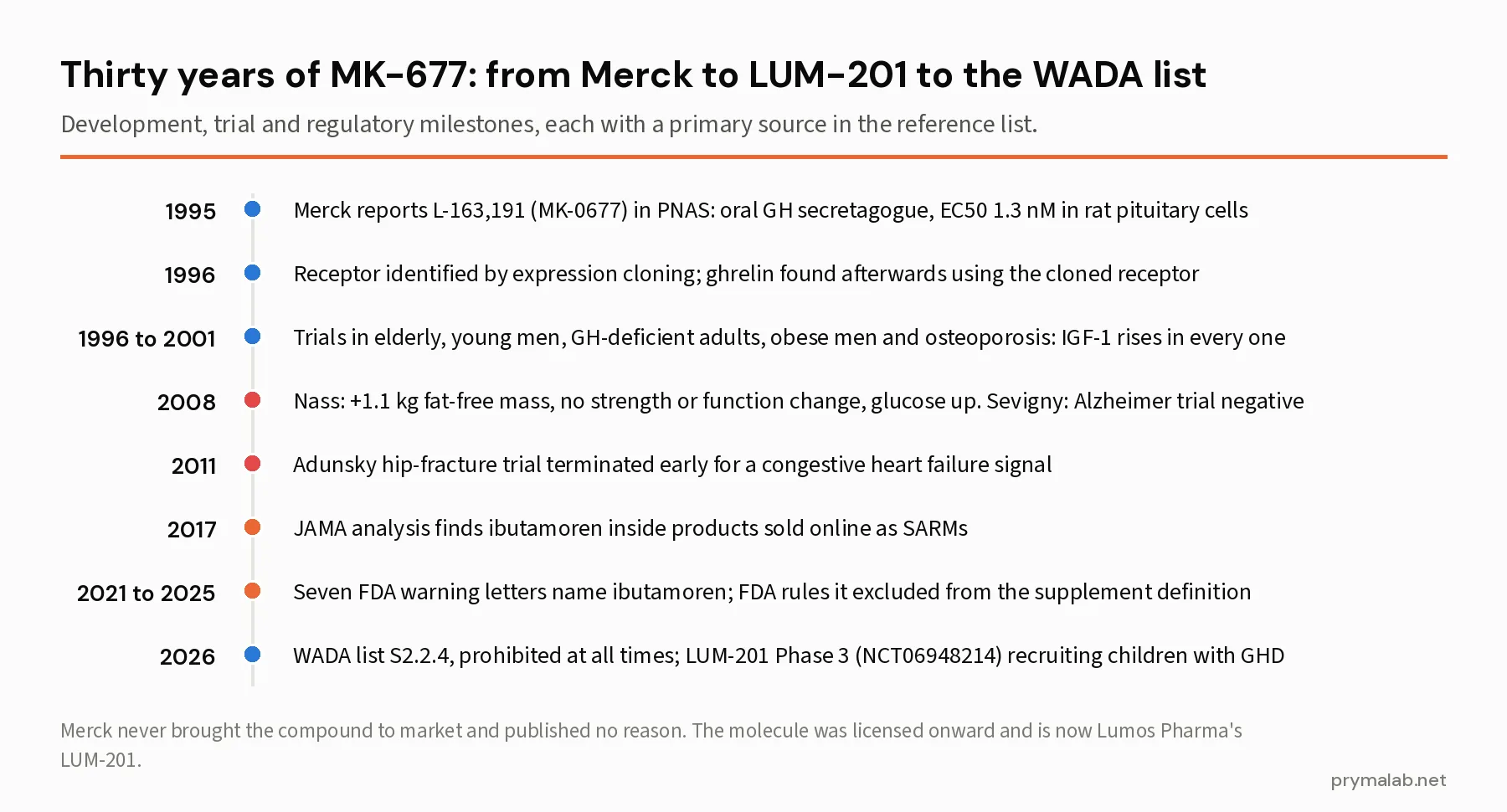
Merck's founding paper, Patchett and colleagues in PNAS in 1995, reported that L-163,191 released GH from rat pituitary cells with an EC50 of 1.3 ± 0.09 nM, raised GH in dogs after oral doses as low as 0.125 mg/kg, and was "mechanistically indistinguishable from the GH-releasing peptide GHRP-6" while "clearly distinguishable from" GHRH.[2] That sentence is the best primary citation for a shared mechanism with the peptide secretagogues, and it is a problem for anyone who wants a sharp line between them.
Why it exists as an oral small molecule at all
The compound was not discovered; it was specified. Roy Smith's 2005 review describes the program as reverse pharmacology: "The objective was to develop small molecules with pharmacokinetics suitable for once-daily oral administration that would rejuvenate the GH/IGF-I axis. Neither the receptor nor the ligand that controlled pulse amplitude of hormone release was known."[3] The receptor was identified by expression cloning afterwards, and ghrelin was found later still using the cloned receptor as bait. Ghrelin was discovered because of compounds like MK-677, not the other way round.
Not a SARM either
A selective androgen receptor modulator is a ligand of the androgen receptor, a nuclear receptor that changes which genes a cell transcribes. Ibutamoren's target is GHS-R1a, a G-protein-coupled receptor on the cell surface. The two share no target, no mechanism and no structural class, and ibutamoren has no androgenic activity. What it shares with SARMs is a sales channel, and I will come back to what that has done to its regulatory record. The receptor-level distinction is in our SARMs vs peptides reference.
How Ibutamoren Works: A Ghrelin Mimetic With a Solved Structure
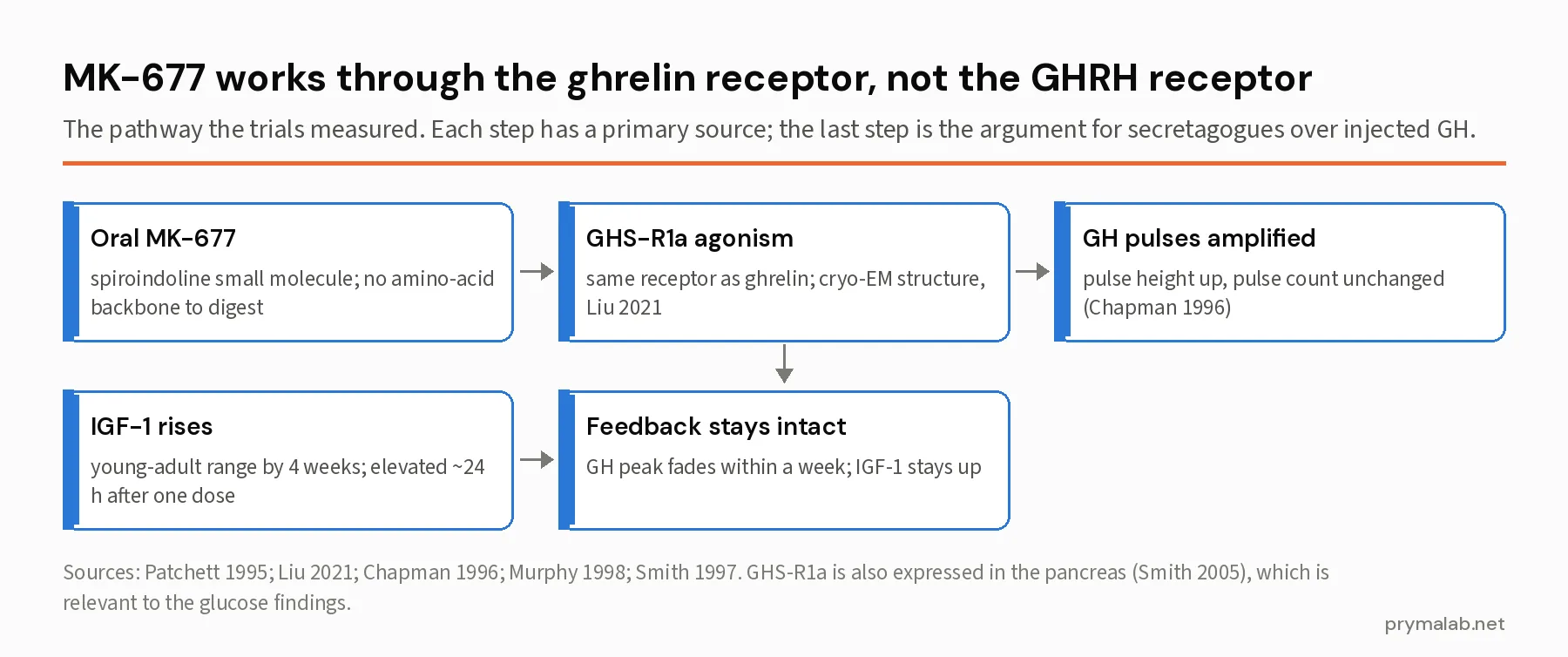
MK-677 works by activating GHS-R1a, the receptor for ghrelin, in the pituitary and hypothalamus. That amplifies the growth hormone pulses the body is already producing, and the extra GH drives the liver to make more IGF-1. It does not act on the GHRH receptor and it contains no growth hormone.
The receptor structure, solved with the drug in it
In 2021 Liu and colleagues published cryo-EM structures of the GHSR-Gi signalling complex bound to ghrelin and, separately, bound to ibutamoren, identifying a salt bridge and an aromatic cluster near the binding pocket as the motifs that matter for activation. The paper calls ibutamoren "an investigational new drug."[4] A solved structure of the drug in the receptor is the strongest kind of evidence for "same receptor as ghrelin," and it is not an inference from functional assays.
Smith reasoned that GH pulse amplitude could be raised four ways, more GHRH release, amplified GHRH signalling in the somatotrophs, less somatostatin release, and antagonism of somatostatin receptor signalling, and concluded that the secretagogues act through all four. The same review records that GHS-R is "expressed predominantly in brain, pituitary gland, and pancreas."[3] Hold on to the pancreas. It comes back in the safety section.
Pulsatile amplification, and the part vendor copy omits
In healthy elderly subjects the standard claim holds. Chapman and colleagues gave 32 volunteers aged 64 to 81 placebo or 2, 10 or 25 mg once daily, sampling blood every 20 minutes for 24 hours. At 25 mg/day, mean 24-hour GH rose 97 ± 23%. Pulse height and interpulse nadir went up; the number of pulses did not change. IGF-1 went from 141 to 219 µg/L at 2 weeks and 265 µg/L at 4 weeks, which the authors described as restoring the young-adult range.[5]
In healthy young men the picture was different. Copinschi's group gave nine men placebo, 5 mg or 25 mg at bedtime for 7 days in a crossover. "The amounts of GH secreted were similar in all three conditions"; what changed was pulse frequency, "primarily because of an increase in the number of low amplitude pulses."[6] IGF-1 still rose. But the 97% figure belongs to people in their seventies whose GH axis had declined. In young men with an intact axis, a week of dosing changed the pattern of GH secretion and not the amount, and that is the population that mostly reads about this compound.
The GH response fades; IGF-1 does not
Murphy's 1998 study measured a peak GH of 55.9 ± 31.7 µg/L after a single 25 mg dose and 22.6 ± 9.3 µg/L after a week of daily dosing, against placebo values of roughly 9 and 7.[7] Svensson's obese-men trial found the same thing: the GH and prolactin rises after the first dose "were significantly greater than the increase seen after multiple doses."[8] IGF-1 stayed up in both, and in every longer trial. That is why IGF-1, not GH, is the durable marker for this compound.
What the MK 677 half life figures actually refer to
Two numbers circulate and they describe different things. The 4 to 6 hour figure is an elimination half-life reported in beagles; the drugbox most pages copy it from attributes it to a 2000 monograph by Smith and Thorner, which I could not open. The 24 hour figure is not a half-life at all. It is how long IGF-1 stays elevated after a single oral dose, reported by Smith's group in 1997, and it is the observation that justified once-daily dosing in every trial.[9] I could not find a published human plasma half-life for ibutamoren, and I could not verify an oral bioavailability percentage from any primary source. If a page quotes either, ask where the number came from.
Appetite is a receptor effect, not a GH effect
The receptor MK-677 activates is the one that carries the hunger signal; the Liu paper opens with ghrelin activating GHSR "to stimulate food intake and growth hormone secretion."[4] Knockout of the receptor in mice confirmed that the secretagogues are ghrelin mimetics.[3] So the appetite increase in the trials is a parallel output of the same receptor. It would be there even if GH did nothing.
The Human Trial Record, Including the Failures
Ibutamoren has the most complete public trial record of any GHS-R1a agonist. Merck ran it through healthy elderly people, young men, GH-deficient adults, obese men, calorie-restricted volunteers, osteoporotic women, hip-fracture patients and Alzheimer's patients between 1996 and 2011. The compound hit its biochemical target every time, and it produced a measurable clinical benefit almost never.
| Study | Population, n | Design | Biomarker | Clinical result |
|---|---|---|---|---|
| Chapman 1996 | Healthy elderly, n=32 | Placebo or 2, 10, 25 mg/day; 14 and 28 days | 24-h GH +97%; IGF-1 to young-adult range | Fasting glucose 5.4 to 6.8 mmol/L[5] |
| Copinschi 1996 | Healthy young men, n=9 | Crossover, 5 or 25 mg at bedtime, 7 days | Total GH unchanged; IGF-1 up | No cortisol effect[6] |
| Copinschi 1997 | Young n=8; older n=6 | Crossover, 7 days; two 14-day periods | IGF-1 up | Stage IV sleep +~50% (young); REM up in both[10] |
| Chapman 1997 | Severely GH-deficient men, n=9 | 10 or 50 mg or placebo, 4 days | IGF-1 +52% and +79% | Insulin and postprandial glucose up[11] |
| Svensson 1998 | Obese men, n=24 | 25 mg/day vs placebo, 8 weeks | IGF-1 +~40% | Fat-free mass up; fat unchanged; OGTT impaired[8] |
| Murphy 1998 | Calorie-restricted volunteers, n=8 | Crossover, 25 mg/day, 7 days | IGF-1 264 vs 188 ng/mL | Nitrogen balance +0.31 vs −1.48 g/day[7] |
| Murphy 1999 | Elderly, three pooled RCTs, n=187 | 2 to 9 weeks | IGF-1 +55 to 94% | Bone formation and resorption markers up[12] |
| Murphy 2001 | Postmenopausal osteoporosis, n=292 | With alendronate, 18 months | IGF-1 +39% and +45% | Femoral neck BMD +4.2% vs +2.5%; no gain elsewhere[13] |
| Bach 2004 | Hip fracture, n=161 | 6 months plus 6 follow-up | IGF-1 +84% vs +17% | No significant functional difference[14] |
| Nass 2008 | Healthy, 60 to 81 y, n=65 | 25 mg/day, 2 years, primary at 1 year | GH and IGF-1 to young-adult levels | FFM +1.1 kg; no strength or function change; glucose up[15] |
| Sevigny 2008 | Mild to moderate Alzheimer's, n=563 | 25 mg/day, 12 months | IGF-1 +72.9% | Negative on all four endpoints[16] |
| Adunsky 2011 | Hip fracture, n=123 | 25 mg/day, 24 weeks | IGF-1 +51.4 ng/mL | Stair power p=0.29; terminated early, heart failure signal[17] |
Two things about that table. Nearly every study used 25 mg once daily, so the dose-response record above that level is four days in nine men and two weeks in thirty. And the only healthy young adults in it are the nine men of Copinschi 1996 and the eight in the sleep study.
The sleep study, and its sample size
The stage IV result is real and it comes from the 1997 Neuroendocrinology paper, not the 1996 JCEM one that several pages cite for it. Eight subjects aged 18 to 30 went through placebo, 5 mg and 25 mg at bedtime for 7 days each. At the high dose, stage IV duration rose roughly 50% and REM more than 20% (p < 0.05), and deviations from normal sleep fell from 42% to 8%. Six older subjects showed a near 50% increase in REM and a shorter REM latency, with no stage IV finding.[10] Eight and six. It has never been replicated in a larger sample.
The strongest positive result is eight people on a diet
Eight volunteers were restricted to 18 kcal/kg/day for two 14-day periods, with 25 mg or placebo during the last 7 days of each. In the drug week, nitrogen balance was +0.31 ± 0.21 g/day against −1.48 ± 0.21 on placebo (P < 0.01), a swing from catabolic to net positive.[7] The authors framed the implication conditionally, "if these short-term anabolic effects are maintained in patients who are catabolic," and no later trial showed that they are. It is a clean pharmacological demonstration and it is not evidence that the compound builds anything in a fed person.
Nass 2008: the trial that matters
The Annals of Internal Medicine trial is the only long controlled study with body composition, strength and function endpoints. It was a 2-year, double-blind, randomised, placebo-controlled, modified-crossover design with primary endpoints of fat-free mass and abdominal visceral fat at 1 year. Seventy-one adults aged 60 to 81 were randomised 2:1; 65 completed the first year and 53 completed 24 months, on 25 mg or placebo orally once daily.[15]
Fat-free mass fell 0.5 kg on placebo and rose 1.1 kg on drug (P < 0.001). Body cell mass, measured as intracellular water, went from −1.0 to +0.8 kg, with the drug arm's confidence interval crossing zero. Abdominal visceral fat: no difference. Total fat: no difference. Limb fat rose 1.1 kg on drug against 0.24 kg on placebo (P = 0.001). Body weight rose 2.7 kg against 0.8. Fasting glucose rose 0.3 mmol/L (P = 0.015) and insulin sensitivity fell. Cortisol rose 47 nmol/L. IGF-1 rose 1.5-fold.
The full text adds what the abstract does not. In four subjects the dose was blindly reduced to 10 mg: two for a rise in fasting glucose, two for joint pain. Femoral neck bone density rose 0.012 g/cm2 on placebo and fell 0.005 g/cm2 on drug over 12 months, read by the authors as increased remodelling. So the compound adds 1.1 kg of fat-free mass, some of which is plausibly water given the edema the same trial reports, adds 1.1 kg of limb fat and 2.7 kg of body weight, raises glucose, and changes nothing a person could feel or measure in a gym.
The Alzheimer trial is negative in its title
Sevigny and colleagues randomised 563 patients with mild to moderate Alzheimer's disease to 25 mg or placebo for 12 months; 416 completed. Serum IGF-1 rose 60.1% at 6 weeks and 72.9% at 12 months. There were no differences on the CIBIC-plus, ADAS-Cog, ADCS-ADL or CDR sum of boxes.[16] The paper is titled "no clinical effect on AD progression in a randomized trial," and its conclusion is that "despite evidence of target engagement" the drug "was ineffective." It is the cleanest biomarker-versus-outcome result in the record.
Two hip-fracture trials, one of them stopped
Bach 2004 enrolled 161 patients aged 65 and over at 13 centres in seven countries, treated for 6 months and followed for 6 more. IGF-1 rose 84% against 17%. There were no significant differences in functional performance; three of four lower-extremity measures leaned toward drug without reaching significance. The authors raised the alternative that "stimulation of GH may not result in significant functional improvement."[14] Congestive heart failure was an exclusion criterion.
Adunsky 2011 was the Phase IIb follow-up: 123 patients, 62 on 25 mg/day and 61 on placebo, for 24 weeks. Stair-climbing power rose 12.5 W with a confidence interval from −10.95 to 35.88 (p = 0.292). Gait speed improved (p = 0.011). "There was no improvement in MK-0677 treated patients in several other functional performance measures." IGF-1 rose 51.4 ng/mL. And then: "Trial was terminated early due to a safety signal of congestive heart failure in a limited number of patients."[17] That sentence gets its own subsection below.
MK 677 Benefits Claims Against the Controlled Data
The benefits attributed to MK-677 on sales pages are muscle gain, fat loss, better sleep, stronger bones and faster recovery. The controlled trials support one of those in part, support one in samples of eight and six, contradict one outright, and split the rest.
| Claim | What the controlled data show | Source |
|---|---|---|
| Muscle gain | Fat-free mass +1.1 kg over 12 months (elderly); up over 8 weeks (obese men). Both by DXA, which counts water. Strength: no change. | Nass 2008; Svensson 1998 |
| Fat loss | Not observed in any trial. Visceral and total fat unchanged at 8 weeks and 12 months; limb fat rose more than placebo. | Svensson 1998; Nass 2008 |
| Sleep | Stage IV +~50% and REM +>20% in eight young men; REM +~50% in six older adults. Never replicated at scale. | Copinschi 1997 |
| Bone | Formation and resorption markers both rise. BMD gain only at the femoral neck, only with alendronate. | Murphy 1999; Murphy 2001 |
| Recovery and function | No significant functional gain after hip fracture in two trials; no function change in healthy elderly. | Bach 2004; Adunsky 2011; Nass 2008 |
| Catabolism | Nitrogen balance turned positive in eight calorie-restricted volunteers over 7 days. | Murphy 1998 |
The muscle claim, and what DXA measures
Fat-free mass by DXA or a four-compartment model includes water. Nass 2008 reports transient lower-extremity edema among the most frequent adverse effects, and body cell mass, the compartment that excludes extracellular water, rose less than fat-free mass with a confidence interval that crossed zero.[15] No trial has measured muscle by a method that excludes fluid. I am not saying the gain is all water. I am saying nobody has shown it is not, and the strength data point the wrong way for contractile tissue.
The fat claim is contradicted, twice
Svensson's obese-men trial was designed to test body composition and it is explicit: "Total and visceral fat were not significantly changed with active therapy." Basal metabolic rate rose at 2 weeks and was no longer raised at 8. The authors closed by saying further studies would be needed to see whether a higher dose or longer treatment "can promote a reduction in body fat," which is a polite way of reporting that this one did not.[8] Twelve months in the Nass trial gave the same answer, with limb fat rising more than placebo. The idea that ibutamoren is a body-recomposition agent has no controlled trial behind it and two against it.
Bone: turnover is not strength
Murphy 1999 pooled 187 elderly adults and found urinary N-telopeptide, a resorption marker, up 10 to 23%, alongside osteocalcin and bone-specific alkaline phosphatase, formation markers, up 8 to 29%.[12] Both sides of remodelling rise together. The 18-month osteoporosis trial found a femoral-neck BMD gain for MK-677 plus alendronate over alendronate alone, 4.2% against 2.5%, and no gain at the lumbar spine, total hip or total body, which the authors called a concern when weighed against the side effects of raised GH secretion.[13] Increased remodelling is not increased bone strength, and the one 12-month trial of the drug alone saw femoral-neck density drift down.
A finding nobody claims: lower testosterone
The same 24 obese men had their endocrine panel published separately. Over 8 weeks, MK-677 reduced serum total testosterone (P < 0.05 versus placebo), with the testosterone to SHBG ratio unchanged; free T3 rose and peak TSH rose within the normal range.[18] The gonadotrophins did not move, so this is not axis suppression of the SARM kind. It is a small signal in a paper about leptin where almost nobody has looked for it.
If the question is what MK 677 before and after results look like in a controlled setting, the answer is the Nass table: 2.7 kg heavier, 1.1 kg more fat-free mass, 1.1 kg more limb fat, the same visceral fat, the same strength, a higher fasting glucose. Forum photographs are not a substitute for that table, and they usually come with compounds that are.
MK-677 vs GHRP-6, Ipamorelin and the Injectable Secretagogues
MK-677, GHRP-6, GHRP-2, hexarelin and ipamorelin all activate GHS-R1a. The differences are chemistry, route and side-hormone profile: MK-677 is an oral small molecule with a day-long IGF-1 effect, the others are injected peptides with short plasma residence. No human trial has compared any of them head to head, and I looked.
| MK-677 | GHRP-6 and GHRP-2 | Ipamorelin | |
|---|---|---|---|
| Chemistry | Spiroindoline sulfonamide, 528.7 g/mol free base | Hexapeptides | Pentapeptide |
| Route in trials | Oral, once daily | Injection | Injection |
| Receptor | GHS-R1a; cryo-EM structure bound | GHS-R1a | GHS-R1a |
| ACTH and cortisol | No rise over days to 8 weeks in five human trials; +47 nmol/L at 12 months in one | Raised ACTH and cortisol in swine | No ACTH or cortisol release in swine, even at >200× the GH ED50 |
| Prolactin | +23% in elderly, within range; transient rise in obese men | Not raised in swine | Not raised in swine |
| Human trial record | Twelve controlled trials, up to 2 years, up to n=563 | Small mechanistic studies | Small mechanistic studies |
| WADA 2026 | S2.2.4, all times | S2.2.4, all times | S2.2.4, all times |
The cortisol comparison, with its actual source
The claim that GHRP-6 and GHRP-2 raise cortisol while ipamorelin and MK-677 do not is repeated everywhere and rarely sourced. The primary source I could open is Raun and colleagues' 1998 paper introducing ipamorelin. In conscious swine, "administration of both GHRP-6 and GHRP-2 resulted in increased plasma levels of ACTH and cortisol," while ipamorelin did not, even at doses more than 200-fold above its ED50 for GH release; none of the compounds moved FSH, LH, prolactin or TSH.[19] That is pig data, and it is the only controlled comparison I could find.
MK-677's cortisol record is human and longer. Patchett saw "only modest increases in cortisol" in dogs.[2] Chapman 1996, Copinschi 1996, Chapman 1997, Murphy 1998 and Svensson 1998 found no meaningful cortisol rise over 4 days to 8 weeks. Nass 2008 found 47 nmol/L, confidence interval 28 to 71, at 12 months.[15] So MK-677's cortisol effect is undetectable over weeks and small but real over a year. "No effect on cortisol" overstates the record by one trial, and it is the longest one.
One more thing cuts against a neat separation: Merck's own paper called MK-677 "mechanistically indistinguishable from the GH-releasing peptide GHRP-6."[2] Same receptor, same downstream pathways; the difference in side-hormone profile is one of degree and dose, not kind. For the peptide side, our references on GHRP-2 vs GHRP-6 and on sermorelin, ipamorelin and tesamorelin cover the injected compounds and the GHRH-receptor agonists MK-677 is sometimes confused with.
The feedback argument, and its limit
The strongest mechanistic case for secretagogues over injected growth hormone is in the Sigalos and Pastuszak review: secretagogues "promote pulsatile release of GH that is subject to negative feedback and can prevent supra-therapeutic levels of GH and their sequelae."[20] The Murphy 1998 attenuation data support it. The same review concludes that "few long-term, rigorously controlled studies have examined the efficacy and safety" of these compounds. Intact feedback limits the size of the GH excursion. It does not tell you what a year of raised IGF-1 does.
MK 677 Side Effects: What the Trials Recorded, Led by the One That Stopped
The recorded adverse effects of MK-677 in controlled trials are increased appetite, fluid retention with lower-extremity edema, muscle and joint pain, raised fasting glucose with reduced insulin sensitivity, small cortisol and prolactin rises, and reduced total testosterone in one 8-week study. The most serious entry is not a case report. It is a randomised trial that its sponsor terminated for congestive heart failure.
The heart failure signal is a trial termination, not an anecdote
Adunsky 2011 bears repeating: "Trial was terminated early due to a safety signal of congestive heart failure in a limited number of patients," and, in the paper's last sentence, "MK-0677 has an unfavorable safety profile in this patient population."[17] A sponsor stopped its own Phase IIb trial. I searched the case-report literature for heart failure attributed to MK-677 and found nothing, which makes the termination both the only cardiac evidence and far stronger than a case report would be.
Two points of context. The population was frail elderly people recovering from hip fracture, and the earlier Bach trial had excluded congestive heart failure where this one evidently did not exclude it as strictly.[14] Fluid retention is a documented effect of raising the GH axis, and the Nass trial recorded edema in healthy elderly subjects.[15] Fluid retention in a frail cardiac population is a plausible mechanism. It has not been established, and I am not asserting it. What I will assert is that this finding is almost never mentioned in consumer-facing material about the compound.
Glucose and insulin: four trials, four populations, one direction
| Trial | Population | Duration | Finding |
|---|---|---|---|
| Chapman 1996 | Healthy elderly, 25 mg | 4 weeks | Fasting glucose 5.4 to 6.8 mmol/L (about 97 to 122 mg/dL), P < 0.01 |
| Chapman 1997 | GH-deficient men, 10 to 50 mg | 4 days | Fasting and postprandial insulin, and postprandial glucose, all up |
| Svensson 1998 | Obese men, 25 mg | 8 weeks | Fasting glucose and insulin unchanged; OGTT impaired at 2 and 8 weeks |
| Nass 2008 | Healthy elderly, 25 mg | 12 months | Fasting glucose +0.3 mmol/L, P = 0.015; insulin sensitivity down; two dose reductions for glucose |
This is the most consistent adverse signal in the literature and the one most reliably left out of vendor material. It is mechanistically coherent: GH opposes insulin action, and GHS-R1a is expressed in the pancreas.[3] Note that Svensson is often misreported as a rise in fasting glucose. The abstract says "fasting concentrations of glucose and insulin were unchanged" and puts the impairment in the oral glucose tolerance test.[8] The fasting-glucose signal belongs to Chapman 1996, where it was large and fast, and Nass 2008, where it was small and slow.[5][15] Sigalos summarises the class as "well tolerated, with some concern for increases in blood glucose because of decreases in insulin sensitivity."[20]
A 2022 case report in Clinical Diabetes describes a 47-year-old recreational bodybuilder who presented with new-onset overt diabetes and 10 kg of weight loss in a month after three months of two SARMs plus ibutamoren at a fraction of the trial dose.[21] Three drugs, one patient, no controls. It cannot attribute anything to ibutamoren; its value is that the direction matches the randomised data.
Appetite, edema, joint pain, and the carpal tunnel question
Nass 2008 lists the most frequent side effects as "an increase in appetite that subsided in a few months and transient, mild lower-extremity edema and muscle pain," and its full text records two dose reductions for joint pain.[15] Murphy 2001 says only that "GH-mediated side effects were noted in the groups receiving MK-677."[13] The appetite detail cuts both ways against vendor copy: some pages promise a lasting appetite increase, some deny any, and the trial says it happens and then fades. Carpal tunnel syndrome is a classic effect of exogenous GH, but I could not find it in any MK-677 abstract or in the Nass full text, so I am not attributing it to this compound.
Prolactin, testosterone, thyroid
Prolactin rose 23% in the healthy elderly, within the normal range; in obese men it rose after the first dose and the rise persisted at 2 and 8 weeks except for the peak value.[5][8] Total testosterone fell in those men over 8 weeks with the free-testosterone index unchanged.[18] None of these is large. All of them are absent from the phrase "no effect on other hormones."
The cancer question is open, and no trial can close it
IGF-1 is mitogenic and anti-apoptotic, and raising it for years is how a long-term cancer concern arises for any GH secretagogue. The concern is raised in the peer-reviewed literature and has never been resolved for MK-677, because the longest controlled exposure is 2 years in 65 people and the largest is 12 months in 563. Sigalos and Pastuszak state the gap plainly: "the safety of these compounds with long-term use, including evaluation of cancer incidence and mortality, is needed."[20] A mechanistic, unresolved concern, not a demonstrated harm.
Case reports, all confounded by co-use
Every published case report involving MK-677 involves something else too. Cardaci and colleagues describe a 25-year-old man who took LGD-4033 with MK-677 for 5 weeks: total fat mass +15.4%, bone mineral density −2.1%, HDL cholesterol −36.4%, ALT +205%, total testosterone −62.3%, most of it reverting afterwards.[22] The liver enzymes and the androgen suppression are the signature of the SARM; nothing in the controlled MK-677 record produces them. The fat gain is consistent with Nass 2008. A 2024 case of reversible gynaecomastia traced to supplements that contained RAD-140, MK-677, cardarine and undisclosed testosterone and estradiol makes the same point from the other side: the products this compound travels in are as much the hazard as the compound.
Legal Status: Unapproved, WADA-Prohibited, and Excluded From the Supplement Definition
Ibutamoren has never been approved for human use in the United States or anywhere else. In the US it is an investigational new drug that the FDA has ruled is excluded from the definition of a dietary supplement, so it cannot lawfully be sold as a supplement or for human consumption. Under the 2026 WADA Prohibited List it is banned at all times. The position outside the US varies by country and I am not describing it here.
Seven FDA warning letters, and the one about a children's product
The research brief I started from could not confirm that any FDA warning letter named ibutamoren, so I searched the agency's database myself on 13 September 2026. A search for "ibutamoren" returned seven letters dated 18 May 2021 to 19 December 2025, to Umbrella, Elite Supplement Center, Warrior Labz SARMS, Musclepower Enterprise (Monster King and GE Labs), Dynamic Health Group (SARMS America), Prime Sports Nutrition and Agebox Inc.[23] Six concern products marketed as SARMs with MK-677 sold alongside them, which is the grouping I flagged earlier.
The seventh is different. On 19 December 2025 the FDA wrote to Agebox Inc. about "iKids-Growth IGF-1 Support" day and night formulas marketed to make children taller: "FDA confirmed through laboratory analysis that samples of both your iKids-Growth products contain the undeclared ingredient ibutamoren mesylate." The letter gives the agency's own adverse-effect language: use "may cause serious side effects including increased appetite, water retention, fatigue, muscle pain, potential alterations in glucose metabolism and insulin sensitivity, and even may increase the potential for congestive heart failure in certain individuals."[23] That is the FDA citing, in effect, the Nass and Adunsky trials.
The legal reasoning is the same across the December 2025 letters and it settles the supplement question. Ibutamoren "is excluded from the dietary supplement definition under section 201(ff)(3)(B)(ii) of the FD&C Act," because it "has been authorized for investigation as a new drug, substantial clinical investigations of ibutamoren as a new drug have been instituted, and the existence of such investigations has been made public," and it "was not marketed as a dietary supplement or as a conventional food prior to such authorization."[23] The trial record in this article is the reason the compound can never be a supplement ingredient in the United States. How the separate legal questions around research compounds fit together is in our reference on whether peptides are legal.
WADA: a non-peptide under a heading that begins with the word peptide
I opened the 2026 Prohibited List, effective 1 January 2026, and read the section. Ibutamoren sits in S2, "Peptide Hormones, Growth Factors, Related Substances, and Mimetics," at S2.2.4, growth hormone releasing factors, in the line "growth hormone secretagogues (GHS) and their mimetics [e.g. anamorelin, capromorelin, ibutamoren (MK-677), ipamorelin, lenomorelin (ghrelin), macimorelin and tabimorelin]." The class is prohibited at all times, in and out of competition, and every substance in it is non-Specified. SARMs are listed separately at S1.2.[24] WADA classifies by biological effect rather than chemistry, and the "mimetics" clause is what carries a spiroindoline sulfonamide into a peptide section. The list is revised every year and subsection numbering has moved before, so S2.2.4 is correct for 2026 and should be re-read when the 2027 list publishes.
What is actually in the products
Van Wagoner and colleagues bought 44 products sold online as SARMs in early 2016 and analysed them with WADA-approved methods. Twenty-three (52%) contained a SARM. Seventeen (39%) contained a different unapproved drug, "including the growth hormone secretagogue ibutamoren," GW501516 and SR9009. Four contained no active compound, 11 contained substances not on the label, and the labelled amount matched the analysed amount in only 18.[25] The abstract does not say how many of the 17 contained ibutamoren specifically, so neither will I.
The European figure is more striking. The official medicines control laboratories network (GEON) ran a five-year surveillance of seized sports products: 324 samples, 14 laboratories, 13 countries, mostly from illegal distribution. Sixty-five percent were presented as medicines and 24% as dietary supplements. Eighteen molecules were found, and the top five in order were ibutamoren, ligandrol, ostarine, cardarine and andarine; "the majority of the samples contain active doses and some are even overdosed."[26] Ibutamoren was the single most-detected compound in the category across 13 countries, and I have not seen that on any consumer page.
LUM-201 Is Ibutamoren, and It Is in Phase 3 Right Now
LUM-201 is not a successor compound or an analogue. It is ibutamoren, licensed onward from Merck and now developed by Lumos Pharma for paediatric growth hormone deficiency. The company's pipeline page opens with "LUM-201, also known as ibutamoren," and the paediatric papers write it as "LUM-201 (ibutamoren, formerly MK-0677)."[27][28] Anyone who says MK-677 was abandoned after the Merck trials is telling half the story.
The Phase 3 trial is NCT06948214: a multicentre, 12-month, randomised, double-blind, placebo-controlled study of daily oral LUM-201 in naive-to-treatment prepubertal children with growth hormone deficiency. When I checked the ClinicalTrials.gov record on 13 September 2026 it was recruiting, with a start date of 20 May 2026, an estimated 150 participants aged 3 to 11, a design of 1.6 mg/kg/day orally against matched placebo capsules, a primary endpoint of annualised height velocity at 12 months, and estimated primary completion in December 2027.[27] That is an active registration trial for the molecule the grey market sells as a bodybuilding product.
Why children, and why a marker
The program uses what Lumos calls a predictive enrichment marker: a screen that selects children whose pituitaries retain enough responsive somatotroph capacity for a secretagogue to work. That answers a finding from 1997. In Chapman's GH-deficient adults, the GH response to MK-677 was greatest in the subjects who were least deficient, correlating with baseline 24-hour GH (r = 0.81) and baseline IGF-1 (r = 0.79).[11] A secretagogue needs a functioning somatotroph population; it cannot replace GH in severe deficiency. Bright and Thorner then compared a single dose of LUM-201 against the standard stimulation tests in 68 children: a median GH response of 15.0 ng/mL against 5.5 ng/mL (p < 0.0001), with the difference greatest in children with higher baseline IGF-1.[28] Same molecule, same rule: it amplifies what is there.
The sponsor's own words, flagged as the sponsor's
Lumos states that LUM-201 has been studied "in more than 1300 patients (more than 150 children)" and was "generally well-tolerated," with the most common adverse events in children being increased appetite, pain in extremity and arthralgia, as of a March 2024 Phase 2 data cut. The page describes its own data as showing that "small increases in GH area under the curve (AUC) from baseline are sufficient to stimulate an increase in growth" in a small study set.[27] Those are company-website claims, not peer-reviewed results. The phrase "small increases" is the sponsor's, and it is a more modest description of the compound than most people selling it would give.
Merck did not bring ibutamoren to market and, as far as I can find, never published why. The trial record is consistent with a compound that converted biochemistry into clinical benefit poorly and then produced a cardiac signal. That is my reading of the evidence, an inference, and it should be labelled as one.
How Ibutamoren Mesylate Is Characterised
Ibutamoren mesylate is a small molecule, so the analytical questions for a research lot differ from those for a peptide. Purity is a reversed-phase HPLC figure with UV detection, identity is confirmed by mass spectrometry against the calculated mass, and for a capsule product the question that matters most is content per capsule and uniformity across capsules, not the purity of the bulk powder.
What a certificate of analysis should show
Three things follow from the structure. The salt: a certificate should say whether the assay is reported as mesylate or free base, because 1 mg of mesylate contains about 0.85 mg of ibutamoren by mass (528.7 divided by 624.8).[1] The stereocentre: the molecule has one, the (2R) carbon of the serine-derived linker, and an achiral HPLC method cannot separate the (S) enantiomer from it, so a purity figure without a chiral method says nothing about enantiomeric purity, the impurity a synthesis is most likely to introduce. Identity: the free-base formula gives a calculated protonated molecule at m/z 529.2, which is what an electrospray spectrum should show whichever salt was weighed, because the counter-ion does not fly with the cation.
The functional groups are stable ones. The sulfonamide is among the most hydrolytically resistant linkages in medicinal chemistry, the amides are tertiary or hindered, and the benzyl ether does not hydrolyse at neutral pH. None of the degradation chemistries that govern peptides, deamidation, methionine oxidation, aspartate cleavage, apply here, which is one more way of saying it is not a peptide.
Why content uniformity is the question for capsules
Van Wagoner found the labelled amount differing substantially from the analysed amount in 59% of products, and the GEON surveillance found seized products that were "overdosed."[25][26] For a research-grade capsule, the relevant certificate entries are assay per capsule and the spread across a sample of capsules, on top of the bulk-powder HPLC purity. A purity of 99% on the powder is compatible with capsules holding half or double the stated content. The reasoning behind purity numbers and why they are not the same as content is in our reference on peptide purity testing; it was written for peptides but the arithmetic transfers. The rules in our storage and stability reference apply loosely at best, because a small-molecule solid is far less fragile than a lyophilised peptide, and reconstitution does not apply at all.
PrymaLab supplies MK-677 ibutamoren for laboratory research use with HPLC purity and mass spectrometry identity on every lot.
What This Article Does Not Settle
That MK-677 improves strength or physical function. The only 12-month controlled trial with strength endpoints says the fat-free mass gain "did not result in changes in strength or function." Two hip-fracture trials found no significant functional benefit, with one secondary gait-speed measure positive in a trial stopped for safety.
That the fat-free mass is muscle, or that fat falls. DXA counts water; edema is a documented effect; body cell mass rose less than fat-free mass with a confidence interval crossing zero. Fat loss has been tested twice and not found; limb fat rose.
Human pharmacokinetics. I could not find a published human plasma half-life or an oral bioavailability figure from a primary source. The 4 to 6 hour figure is a beagle number and the 24 hour figure is the duration of IGF-1 elevation.
Cardiac safety in anyone who is not a frail hip-fracture patient. One trial surfaced a congestive heart failure signal and was stopped. No trial has since characterised it, so its relevance to other populations is unknown in both directions.
Cancer risk from years of raised IGF-1. Raised in the literature, never tested. The longest controlled exposure is 2 years in 65 people.
Why Merck stopped, and whether the sponsor's paediatric claims hold. No document states Merck's reason. Lumos's "more than 1300 patients" and "generally well-tolerated" are company-website statements awaiting the Phase 3 readout, estimated for December 2027.
What is well established: the structure, the two molecular weights and CAS numbers, the receptor and its solved structure, the GH and IGF-1 pharmacodynamics, the Merck-era trial record including the negative results and the termination, the FDA's exclusion ruling and warning letters, and the 2026 WADA listing. Those are checkable in the sources below.
Frequently Asked Questions
Is MK 677 a peptide?
No. It is a spiroindoline sulfonamide small molecule with no amino-acid backbone. It shares a receptor with GHRP-6 and ipamorelin, not a chemistry.
What is ibutamoren?
The INN for MK-677: an oral small-molecule ghrelin-receptor agonist that Merck designed in 1995 and Lumos Pharma now develops as LUM-201. Sold as the mesylate salt, CAS 159752-10-0.
Is MK-677 a SARM?
No. SARMs act on the androgen receptor; MK-677 acts on the ghrelin receptor. They are sold together, which is why they are confused, and WADA lists them in different sections.
What is the MK 677 half life?
The 4 to 6 hour figure is from beagles and the 24 hour figure is the duration of the IGF-1 rise, not a half-life. I could not find a published human plasma half-life.
Is MK-677 FDA approved?
No, and it never has been anywhere. It is an investigational drug, currently in a Phase 3 paediatric trial as LUM-201, and the FDA has ruled it cannot be sold as a dietary supplement.
What MK 677 side effects did the clinical trials record?
Appetite, edema, muscle and joint pain, higher fasting glucose and lower insulin sensitivity, small cortisol and prolactin rises, and one trial stopped early for a congestive heart failure signal.
What do MK 677 before and after results look like in controlled trials?
In the 12-month trial: fat-free mass +1.1 kg, body weight +2.7 kg, limb fat +1.1 kg, no change in visceral fat, strength or function. No controlled trial has recorded fat loss.
Does MK-677 raise cortisol or prolactin?
Short-term trials found no cortisol change; the 12-month trial found a small rise of 47 nmol/L. Prolactin rose modestly and, in part, transiently.
What is the difference between MK-677 and ipamorelin?
Same receptor, different chemistry and route: ipamorelin is an injected pentapeptide, MK-677 an oral small molecule. No head-to-head human trial exists.
Is MK-677 banned by WADA?
Yes. The 2026 Prohibited List names ibutamoren (MK-677) in section S2.2.4, prohibited at all times, in and out of competition.
References
- PubChem. Ibutamoren, CID 178024 (free base, IUPAC name, CAS 159634-47-6) and ibutamoren mesylate, CID 6450830 (CAS 159752-10-0, 624.8 g/mol, synonyms including Nutrobal). CID 178024 and CID 6450830
- Patchett AA, Nargund RP, Tata JR, et al. Design and biological activities of L-163,191 (MK-0677): a potent, orally active growth hormone secretagogue. Proc Natl Acad Sci USA. 1995;92(15):7001-7005. PMID 7624358. DOI
- Smith RG. Development of growth hormone secretagogues. Endocr Rev. 2005;26(3):346-360. PMID 15814848. Reverse pharmacology, the four mechanisms, receptor distribution. DOI
- Liu H, Sun D, Myasnikov A, et al. Structural basis of human ghrelin receptor signaling by ghrelin and the synthetic agonist ibutamoren. Nat Commun. 2021;12(1):6410. PMID 34737341. DOI
- Chapman IM, Bach MA, Van Cauter E, et al. Stimulation of the growth hormone (GH)-insulin-like growth factor I axis by daily oral administration of a GH secretogogue (MK-677) in healthy elderly subjects. J Clin Endocrinol Metab. 1996;81(12):4249-4257. PMID 8954023. DOI
- Copinschi G, Van Onderbergen A, L'Hermite-Baleriaux M, et al. Effects of a 7-day treatment with a novel, orally active, growth hormone (GH) secretagogue, MK-677, on 24-hour GH profiles, insulin-like growth factor I, and adrenocortical function in normal young men. J Clin Endocrinol Metab. 1996;81(8):2776-2782. PMID 8768828. DOI
- Murphy MG, Plunkett LM, Gertz BJ, et al. MK-677, an orally active growth hormone secretagogue, reverses diet-induced catabolism. J Clin Endocrinol Metab. 1998;83(2):320-325. PMID 9467534. DOI
- Svensson J, Lonn L, Jansson JO, et al. Two-month treatment of obese subjects with the oral growth hormone (GH) secretagogue MK-677 increases GH secretion, fat-free mass, and energy expenditure. J Clin Endocrinol Metab. 1998;83(2):362-369. PMID 9467542. DOI
- Smith RG, Van der Ploeg LH, Howard AD, et al. Peptidomimetic regulation of growth hormone secretion. Endocr Rev. 1997;18(5):621-645. PMID 9331545. Duration of IGF-1 elevation after a single oral dose. The 4 to 6 hour beagle half-life is attributed by the drugbox to Smith RG, Thorner MO (eds), Human Growth Hormone: Research and Clinical Practice, Humana, 2000, p. 45, which I could not open. DOI
- Copinschi G, Leproult R, Van Onderbergen A, et al. Prolonged oral treatment with MK-677, a novel growth hormone secretagogue, improves sleep quality in man. Neuroendocrinology. 1997;66(4):278-286. PMID 9349662. DOI
- Chapman IM, Pescovitz OH, Murphy G, et al. Oral administration of growth hormone (GH) releasing peptide-mimetic MK-677 stimulates the GH/insulin-like growth factor-I axis in selected GH-deficient adults. J Clin Endocrinol Metab. 1997;82(10):3455-3463. PMID 9329386. DOI
- Murphy MG, Bach MA, Plotkin D, et al. Oral administration of the growth hormone secretagogue MK-677 increases markers of bone turnover in healthy and functionally impaired elderly adults. J Bone Miner Res. 1999;14(7):1182-1188. PMID 10404019. DOI
- Murphy MG, Weiss S, McClung M, et al. Effect of alendronate and MK-677 (a growth hormone secretagogue), individually and in combination, on markers of bone turnover and bone mineral density in postmenopausal osteoporotic women. J Clin Endocrinol Metab. 2001;86(3):1116-1125. PMID 11238495. DOI
- Bach MA, Rockwood K, Zetterberg C, et al. The effects of MK-0677, an oral growth hormone secretagogue, in patients with hip fracture. J Am Geriatr Soc. 2004;52(4):516-523. PMID 15066065. DOI
- Nass R, Pezzoli SS, Oliveri MC, et al. Effects of an oral ghrelin mimetic on body composition and clinical outcomes in healthy older adults: a randomized trial. Ann Intern Med. 2008;149(9):601-611. PMID 18981485. Full text (PMC2757071) for the randomisation count, dose reductions and femoral neck BMD. PMC
- Sevigny JJ, Ryan JM, van Dyck CH, et al. Growth hormone secretagogue MK-677: no clinical effect on AD progression in a randomized trial. Neurology. 2008;71(21):1702-1708. PMID 19015485. DOI
- Adunsky A, Chandler J, Heyden N, et al. MK-0677 (ibutamoren mesylate) for the treatment of patients recovering from hip fracture: a multicenter, randomized, placebo-controlled phase IIb study. Arch Gerontol Geriatr. 2011;53(2):183-189. PMID 21067829. DOI
- Svensson J, Carlsson B, Carlsson LM, et al. Discrepancy between serum leptin values and total body fat in response to the oral growth hormone secretagogue MK-677. Clin Endocrinol (Oxf). 1999;50(4):451-456. PMID 10468903. Testosterone, thyroid and leptin findings. DOI
- Raun K, Hansen BS, Johansen NL, et al. Ipamorelin, the first selective growth hormone secretagogue. Eur J Endocrinol. 1998;139(5):552-561. PMID 9849822. DOI
- Sigalos JT, Pastuszak AW. The safety and efficacy of growth hormone secretagogues. Sex Med Rev. 2018;6(1):45-53. PMID 28400207. DOI
- Sotornik R, Suissa R, Ardilouze JL. Could overt diabetes be triggered by abuse of selective androgen receptor modulators and growth hormone secretagogues? A case report and review of the literature. Clin Diabetes. 2022;40(3):373-379. PMID 35983415. DOI
- Cardaci TD, Machek SB, Wilburn DT, et al. LGD-4033 and MK-677 use impacts body composition, circulating biomarkers, and skeletal muscle androgenic hormone and receptor content: a case report. Exp Physiol. 2022;107(12):1467-1476. PMID 36303408. The 2024 gynaecomastia case is Chong S, et al. JCEM Case Rep. 2024;2(8):luae148, PMID 39145153. DOI
- US Food and Drug Administration, Warning Letters database, searched for "ibutamoren" on 13 September 2026: seven letters, 18 May 2021 to 19 December 2025. Quoted: Agebox Inc., MARCS-CMS 718252, 19 December 2025, and Musclepower Enterprise Ltd. dba Monster King and GE Labs, MARCS-CMS 719339, 12 December 2025. Agebox letter and Musclepower letter
- World Anti-Doping Agency. The 2026 Prohibited List, effective 1 January 2026. Section S2.2.4 names ibutamoren (MK-677); SARMs are at S1.2. WADA 2026 list (PDF)
- Van Wagoner RM, Eichner A, Bhasin S, Deuster PA, Eichner D. Chemical composition and labeling of substances marketed as selective androgen receptor modulators and sold via the internet. JAMA. 2017;318(20):2004-2010. PMID 29183075. DOI
- Barrios MM, Deconinck E, Vanhee C, et al. SARMs, metabolic modulators and growth hormone secretagogues in suspected illegal medicines, bought as sport performance enhancers: a retro- and prospective study within the GEON. Drug Test Anal. 2025;17(10):2078-2085. PMID 40551438. DOI
- Lumos Pharma, LUM-201 pipeline page (sponsor statements), and ClinicalTrials.gov record NCT06948214, Phase 3 OraGrowtH trial, last updated 4 September 2026. Lumos Pharma and ClinicalTrials.gov
- Bright GM, Thorner MO. A GH secretagogue receptor agonist (LUM-201) elicits greater GH responses than standard GH secretagogues in subjects of a pediatric GH deficiency trial. Horm Res Paediatr. 2022;95(1):76-81. PMID 35354138. DOI
Trial figures are taken from the published abstracts, the Nass 2008 full text, FDA and WADA documents and the sponsor's registration record as cited, current to 13 September 2026. Where a figure could not be verified against a primary source, that is stated in the text. Regulatory positions described are United States federal decisions and the WADA list; they should not be assumed to apply elsewhere.
Final disclaimer: This article is an educational research reference on the chemistry, mechanism, clinical trial record and regulatory status of ibutamoren (MK-677). Compounds supplied by PrymaLab are sold and studied for laboratory research use only and are not approved by any regulatory authority for human or veterinary use. Statements have not been evaluated by the FDA. Nothing here is medical advice, administration guidance, or a treatment claim.
The investigational drug studied by Merck and by Lumos Pharma as LUM-201 is described for scientific and regulatory context only, and its inclusion does not describe or support any use of research-grade material. Trial dose arms are reported as study design facts. Always verify the legal status of any research compound in your jurisdiction before purchase or use.